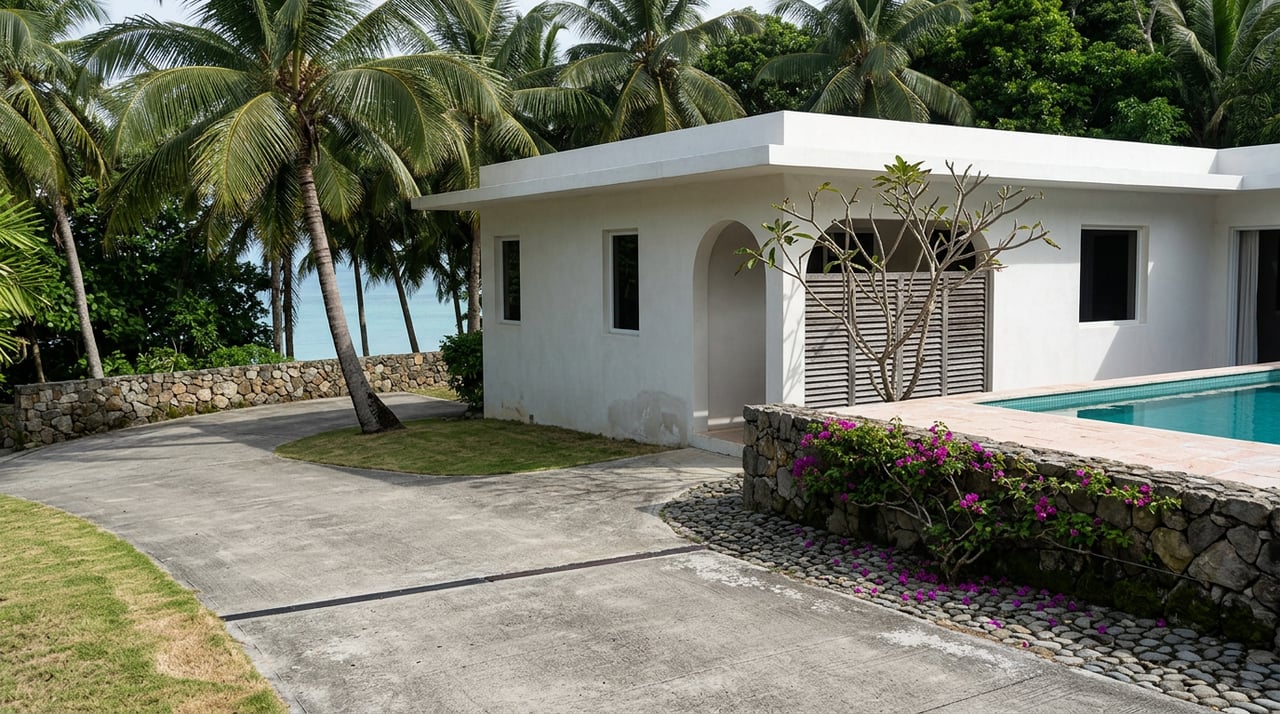
A buyer under contract on a Chocolate Hole lot calls the Virgin Islands Department of Planning and Natural Resources to ask about a building permit. That call is necessary, but it is only one part of the process. Before DPNR reviews a site plan in this neighborhood, the Estate Chocolate Hole Landowners' Association requires members to be current on dues and to comply with its building code. Buyers should include those requirements in their due diligence.
Chocolate Hole includes a private landowners' association with its own rules and road budgets. Its review of development proposals may involve water and sewage, so buyers should consider association requirements alongside government zoning.
ECHLA's Building Code and Covenants
Estate Chocolate Hole was platted into several hundred residential lots in the early 1950s, and the landowners who bought into it formed ECHLA in 1984 to govern what happens on that land. The association's own legal page is direct about how this works: before a member's building plans are even considered, that member has to be current on ECHLA assessments and dues for the lot in question. The building code sits inside the covenants and restrictions written into the warranty deed every buyer signs at closing, not in a county ordinance a title search would flag separately.
For a land-and-build buyer, this changes the due diligence sequence. A parcel can be zoned correctly under USVI law and still stall at ECHLA if the previous owner left dues unpaid or if the proposed structure conflicts with the association's building code. Anyone financing a build should confirm ECHLA standing on the specific lot before assuming a government permit is the only checkpoint left.
Three Roads, Three Bills
Chocolate Hole is still split into three separately governed sections today: North, East, and West, the same division ECHLA describes on its own site. Each section runs its own road caucus with its own annual per-lot fee and its own paving priorities, and the gap between them can be wide. In minutes from ECHLA's 2018-2019 annual meeting, the West caucus set its fee at $500 per lot and used the money to grade roads, dig drainage swales, and complete a paving project on Laughing Gull Lane, while the North caucus, still working off a deficit carried over from 2017, held its fee at $400 per lot and could only afford brush clearing that year, with paving pushed into a future season. East assessed $500 per lot on its own separate track. The dollar figures from that meeting are eight years old and have likely moved since, but the structure they illustrate has not: three budgets, three paving schedules, one estate.
The practical result is that two Chocolate Hole addresses a few hundred yards apart can have very different road conditions depending on which caucus's budget they fall under and how that caucus has managed deficits in past years. A buyer comparing two lots on paper should ask which road committee covers each one and what that committee's current paving backlog looks like, because ECHLA's dues structure, not a single islandwide standard, decides whether the last stretch to the driveway is smooth or graded dirt.
Wastewater Infrastructure and Private Laterals
Estate Chocolate Hole sits on wastewater infrastructure that has been failing for a long time. The Virgin Islands Waste Management Authority's Power Boyd Pump Station, located in the estate, had a documented discharge-pipe break as far back as December 2016. In June 2026, VIWMA officials said crews hoped to resolve renewed pump station issues that had caused unsanitary conditions in the neighborhood, describing a sewer collection system that has simply outlived its design life.
VIWMA officials told The St. John Source, "Our sewer collection system has exceeded its intended service life in many locations."
That line was not specific to Chocolate Hole. Officials used it to describe the entire territory's wastewater network, one prone to sudden line failures, collapses, and blockages, and the pattern has continued to show up close to home. On August 24, 2026, before this was written, VIWMA reported the Cruz Bay Pump Station temporarily offline due to mechanical issues, causing wastewater overflow in the surrounding area. The agency told territorial senators on July 22, 2026 that a full replacement of the wastewater system, funded by roughly $3.2 billion in FEMA money, is not expected to be complete until 2034. Officials also confirmed that federal funds cannot pay for private sewer laterals, the lines connecting individual homes to the public main, which means aging lateral connections on older Chocolate Hole properties are the homeowner's responsibility to repair, not the government's.
For a buyer evaluating an older home in the estate, that is the number that matters more than any paint job or view premium: any fix announced this year is a patch on a system with roughly eight more years of scheduled work ahead of it, and the part of that system closest to your house may not be covered at all.
What This Actually Means for a Buyer
Before writing an offer on a Chocolate Hole property, a few questions are worth answering directly rather than assuming a home inspection will surface them:
- Is the seller's ECHLA account current, and will the association confirm that in writing before closing?
- Which road caucus, North, East, or West, maintains the specific road serving this lot, and what is that caucus's recent paving history?
- Does the home connect to a private sewer lateral, and when was it last inspected or replaced?
- If the lot is intended for subdivision, does it meet ECHLA's half-acre minimum per resulting parcel?
None of these show up on a standard MLS sheet, and none of them are questions a government permit office can answer, because the answers live with the association and with the homeowner, not with DPNR.
Pond Bay Club and ECHLA's Review
The St. John Source reported on the history of the property now known as Pathos Bay, formerly the Pond Bay Club. The site was planned as a condominium resort in 1985, construction on it was shut down in 2013, and developer Legacy Development bought the property in 2016 hoping to finish it with a resort management partner. Hurricanes Irma and Maria, then the pandemic, slowed that plan further.
The report described how, by the spring of 2020, Legacy's managing partner, Dan Lowe, agreed to sell two buildings, with enough land attached to each to meet ECHLA's half-acre subdivision minimum. The association's board was awaiting a plan for how the remaining lots would receive water and sewage service before considering a broader subdivision, and years after the original 1985 concept, the master plan had not been delivered to the board's satisfaction. In the report, then-ECHLA president Kevyn Salsburg described the site as "a hybrid," neither the resort it was permitted as nor the subdivision the market wanted, citing questions about water and sewage infrastructure.
The history shows that association review of water and sewage plans is one part of development due diligence in Chocolate Hole, alongside government approvals.
The Point, Plainly
St. John's average sale price ran near $1.83 million over the trailing twelve months into 2026, and one island brokerage's year-end review reported forty-seven homes sold across the island in the twelve months ending in January 2026, closing within about 9 percent of list price on average. At that price level, a buyer who skips the ECHLA question and the sewer-lateral question is not saving time. They are deferring a conversation that will happen anyway, either during due diligence or after closing when it is far more expensive to have.
For buyers in Chocolate Hole, questions about the association belong alongside questions about the government permit process and the property's setting.
FAQ
Do I automatically become an ECHLA member when I buy a lot in Chocolate Hole? Membership and the association's covenants and restrictions are conveyed through the warranty deed at the time of purchase, so buying a lot in the estate brings ECHLA membership and its building code obligations with it.
If VIWMA's repairs stop at the property line, who pays to fix a failing private lateral? Federal recovery funding cannot be used on private property, so homeowners are responsible for the sewer lateral connecting their home to the public main, a cost worth investigating before closing on an older property in the estate.
How does ECHLA's half-acre rule affect a parcel I want to subdivide? Any resulting lot from a subdivision needs to meet the association's half-acre minimum, the same standard that shaped the Pond Bay Club sale, so a larger parcel does not automatically support as many buildable lots as the acreage alone might suggest.
Buying land or a home in an estate like Chocolate Hole means reading two rulebooks instead of one. Tropical Properties VI has spent decades on St. John working through exactly this kind of local detail with buyers before they write an offer. Browse Properties to see what is currently available in Chocolate Hole and across the island.
This article is general information, not legal, tax or financial advice. Consult a qualified professional about your situation.